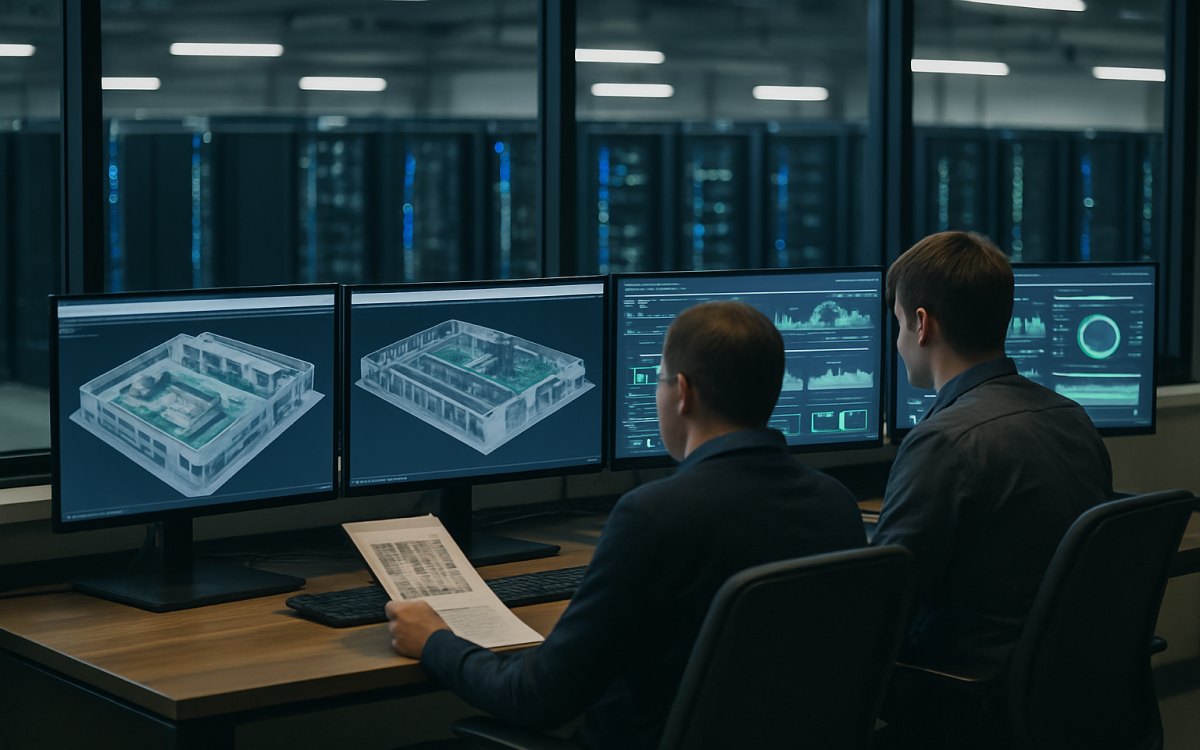
As demand for cloud computing, AI applications, streaming platforms, and digital services continues to rise, expanding a data centre has become more complex than ever. Operators now need better ways to plan infrastructure, reduce operational risks, and improve long-term efficiency. This is where digital twins are making a significant difference. By creating virtual replicas of physical facilities, digital twin technology helps you test expansion strategies, monitor performance, and make informed decisions before investing in costly infrastructure upgrades or large-scale deployments.
Digital Twins in Data Centres
A digital twin is a virtual representation of a physical asset, system, or facility. In a data centre environment, this virtual model replicates infrastructure components such as servers, cooling systems, power distribution units, racks, network equipment, and environmental conditions.
The system continuously receives real-time data from sensors and monitoring tools installed within the facility. This information allows the digital twin to mirror actual operating conditions with high accuracy.
Unlike traditional monitoring systems that only display current performance, digital twins simulate how infrastructure will behave under different conditions. This gives you the ability to test future expansion scenarios without affecting live operations.
As facilities grow more sophisticated, digital twin platforms are becoming an important part of infrastructure planning and lifecycle management.
Why Expansion Planning Has Become More Challenging
Modern expansion projects involve far more than adding extra server racks. You must consider energy availability, cooling efficiency, floor space, network connectivity, security, compliance requirements, and long-term scalability.
Rapid growth in AI workloads and high-density computing has added another layer of complexity. These systems generate significant heat and require advanced cooling strategies. At the same time, organisations want faster deployment timelines and lower operational costs.
Without accurate forecasting, expansion projects can create issues such as power overloads, cooling inefficiencies, uneven airflow distribution, underutilised infrastructure, rising operational expenses, and increased downtime risks.
Digital twins help reduce these challenges by providing a detailed simulation environment before physical changes begin.
Improving Capacity Planning
One of the biggest advantages of digital twins is improved capacity planning. Instead of relying on estimates alone, you can analyse actual infrastructure behaviour using real operational data.
The digital twin allows you to evaluate:
- Available rack space
- Power consumption trends
- Cooling capacity limits
- Future equipment requirements
- Workload distribution patterns
This visibility helps you determine how much additional infrastructure the facility can support without compromising performance.
For example, if you plan to introduce high-density AI servers, the digital twin can simulate the impact on cooling systems, airflow, and energy usage. You can then adjust the design before deployment.
This reduces the risk of overbuilding or underestimating future requirements.
Supporting Faster Expansion Decisions
Expansion projects often involve multiple stakeholders, including infrastructure teams, operations managers, architects, contractors, and investors. Delays in decision-making can increase project costs and extend deployment timelines.
Digital twins simplify collaboration by providing a shared visual model of the facility. Teams can analyse the same real-time information and test different expansion scenarios together.
You can quickly compare design options, evaluate infrastructure changes, and identify potential bottlenecks before construction starts.
This accelerates approval processes and improves coordination between technical and business teams.
Faster planning is particularly valuable in regions where digital demand is growing rapidly and infrastructure deployment timelines are becoming shorter.
Enhancing Cooling and Energy Efficiency
Cooling and power management remain critical concerns during any data centre expansion. As server densities increase, traditional cooling strategies may no longer deliver sufficient performance.
Digital twins help you model airflow behaviour, temperature variations, and energy consumption patterns across the facility. These simulations identify areas where cooling performance may weaken after expansion.
You can test strategies such as:
- Rear-door heat exchangers
- Liquid cooling systems
- Hot aisle containment
- Cold aisle optimisation
- Variable speed cooling units
By analysing these scenarios virtually, you can select the most efficient solution before making physical investments.
The system also helps improve Power Usage Effectiveness (PUE) by identifying unnecessary energy consumption and inefficient resource allocation.
This approach supports both operational efficiency and sustainability goals.
Reducing Operational Risks
Infrastructure expansion always carries some level of operational risk. Even small configuration changes can affect power stability, cooling performance, or network reliability.
A digital twin allows you to test these changes safely in a virtual environment first.
For example, before adding new racks or upgrading electrical systems, you can simulate how the infrastructure responds under peak workloads. This helps identify vulnerabilities before they affect live services.
Digital twins also support predictive analysis. The system can detect trends that indicate future performance issues, such as overheating zones or power imbalances.
As a result, you can address problems proactively instead of reacting after failures occur.
This level of visibility is especially valuable for facilities supporting critical financial services, healthcare platforms, cloud computing, and AI workloads.
Improving Space Utilisation
Space constraints are becoming more common as urban infrastructure demand increases. Building additional facilities is expensive, so operators want to maximise the efficiency of existing space wherever possible.
Digital twins provide detailed visualisation of rack layouts, airflow paths, equipment positioning, and cable management systems.
This helps you identify:
- Unused floor space
- Inefficient rack arrangements
- Airflow obstructions
- Redundant infrastructure zones
With better visibility, you can redesign layouts to support additional capacity within the same footprint.
Efficient space planning also improves maintenance accessibility and future scalability.
Supporting Sustainability Targets
Sustainability has become a major focus area in modern infrastructure planning. Expansion projects now require careful management of energy consumption, water usage, and carbon emissions.
Digital twins contribute to sustainability by improving resource efficiency throughout the facility lifecycle.
The technology allows you to:
- Monitor energy performance continuously
- Reduce unnecessary cooling demand
- Improve equipment utilisation
- Minimise infrastructure waste
- Extend asset lifespan
Some operators also use digital twins to evaluate renewable energy integration and battery storage systems during expansion planning.
As environmental standards continue to evolve, digital twins provide the operational insight needed to support compliance and long-term sustainability objectives.
Enabling Better Financial Planning
Expanding a data center involves significant capital investment. Poor planning can lead to underused infrastructure, rising operating costs, or expensive redesigns later.
Digital twins improve financial forecasting by providing accurate infrastructure simulations and performance modelling.
You can estimate:
- Future energy costs
- Cooling requirements
- Equipment lifespan
- Maintenance expenses
- Capacity growth timelines
This helps create more realistic investment plans and reduces uncertainty during budgeting discussions.
The ability to test multiple expansion scenarios also allows you to compare cost-performance outcomes before committing resources.
For investors and operators, this improves financial confidence and long-term infrastructure planning.
Integrating AI and Automation
Digital twin platforms increasingly work alongside AI-driven analytics and automation systems. Together, these technologies improve infrastructure management during and after expansion projects.
AI tools analyse operational data from the digital twin to identify optimisation opportunities automatically. The system may recommend cooling adjustments, workload redistribution, or infrastructure upgrades based on changing conditions.
Automation can also support real-time responses to operational issues. For example, if the system detects rising temperatures in a specific zone, cooling systems can adjust automatically before performance is affected.
This combination of digital twins and AI creates smarter, more adaptive infrastructure environments.
As computing demands continue to evolve, automation will likely play a larger role in future facility management strategies.
Growing Importance of Real-Time Visibility
Traditional infrastructure planning often relies on static reports and periodic audits. These methods provide limited visibility into rapidly changing operational conditions.
Digital twins offer continuous real-time monitoring instead. This allows you to track how the facility performs throughout every stage of expansion.
Real-time visibility supports:
- Faster troubleshooting
- Better infrastructure forecasting
- Improved resource allocation
- More accurate maintenance planning
- Reduced downtime risks
For large facilities with complex infrastructure systems, this level of insight is becoming increasingly valuable.
Operators can make informed decisions based on live operational data rather than assumptions or outdated reports.
Challenges in Digital Twin Adoption
Although digital twins offer significant benefits, implementation still requires careful planning.
Building an accurate digital model depends on reliable sensor networks, high-quality infrastructure data, and integration with existing monitoring systems. Older facilities may require upgrades before digital twin technology can function effectively.
Initial deployment costs can also be substantial, particularly for large campuses with complex infrastructure environments.
In addition, organisations need skilled professionals who understand data analytics, infrastructure engineering, and digital modelling systems.
However, as the technology matures, adoption costs are gradually becoming more manageable for a wider range of operators.
Digital twins are transforming how modern data centres approach expansion planning. By creating accurate virtual models of physical infrastructure, these systems help you improve capacity planning, reduce operational risks, optimise energy efficiency, and make better investment decisions.